The biggest mistake first-timers make in Everglades National Park is trying to “do it all” in one day. That sounds efficient, but this iconic River of Grass spans 1.5 million acres, and its sections are spread far apart. The park rewards a slower pace.
For a single day, the simplest plan is to use the Homestead entrance. It gives first-timers the best mix of wildlife, easy walks, and scenic driving without turning the day into a car marathon.
Before you go
A few logistics matter more here than at most national parks, mostly because of how the Everglades is laid out.
- The park has three separate entrances in three different cities: Homestead (southeast), Shark Valley off the Tamiami Trail (central), and Everglades City on the Gulf Coast (northwest). They are not connected to each other. Each entrance, plus the interior Flamingo area, sits at least a one-hour drive apart, so you pick one area per day.
- Entry is $35 per private vehicle, good for seven consecutive days at all entrances. On foot or by bike it is $20 per person, and visitors 15 and under are free. The park is cashless, so bring a card or buy a digital pass ahead of time.
- Plan around the dry season, roughly December through April. Lower water levels concentrate wildlife at the remaining ponds, mosquitoes are far more bearable, and the weather is milder. The wet season from May to November brings heat, heavy bugs, and afternoon storms.
- Arrive early. The entrance gates stay open 24 hours but are busiest on winter weekends, so a start before 10 a.m. means cooler trails and better odds of seeing gators and birds.
- Bring water, sun protection, and bug spray. The Everglades can feel mild until it suddenly doesn’t.
Start at the Homestead entrance, not everywhere at once
For a first visit, the ideal one-day itinerary starts at the main Homestead entrance near the Ernest F. Coe Visitor Center, a convenient spot for visitors driving from Miami. It is the easiest way to string together several classic spots on one clean route: short boardwalks, open marsh views, shaded hammocks, and the long drive south to Flamingo.
Pick one section of the park. The Everglades is bigger than it looks, and cross-park driving burns your best wildlife hours.
From Miami, the Homestead entrance is about an hour’s drive, and Shark Valley is closer to 45 minutes. Whichever you choose, it is worth checking the National Park Service app the night before for current conditions and any road closures.
If you’re building a bigger Florida parks trip, this free tool to plan your Everglades National Park visit can help sort out the logistics fast. For broader park context before you go, Lonely Planet’s first-time guide is a solid overview.
A one-day route from Royal Palm to Flamingo
This route works because it keeps the stops short and memorable. Nothing here feels rushed as long as you keep moving and don’t linger too long at every pullout.
- Ernest F. Coe Visitor Center, first thing in the morning. Stop briefly, grab a map, fill water, and ask about recent wildlife sightings.
- Anhinga Trail, the best first stop in the park and the one not to skip. This short boardwalk loop is the single best short wildlife walk in the Everglades.
- Gumbo Limbo Trail, a short, shaded contrast to the open water views.
- Pa-hay-okee Overlook and Mahogany Hammock, two quick stops that show off different sides of the Everglades.
- Flamingo, in the afternoon. Finish near the marina at the southern end of the Main Park Road, 38 miles south of the entrance, and enjoy the wide-open feel.
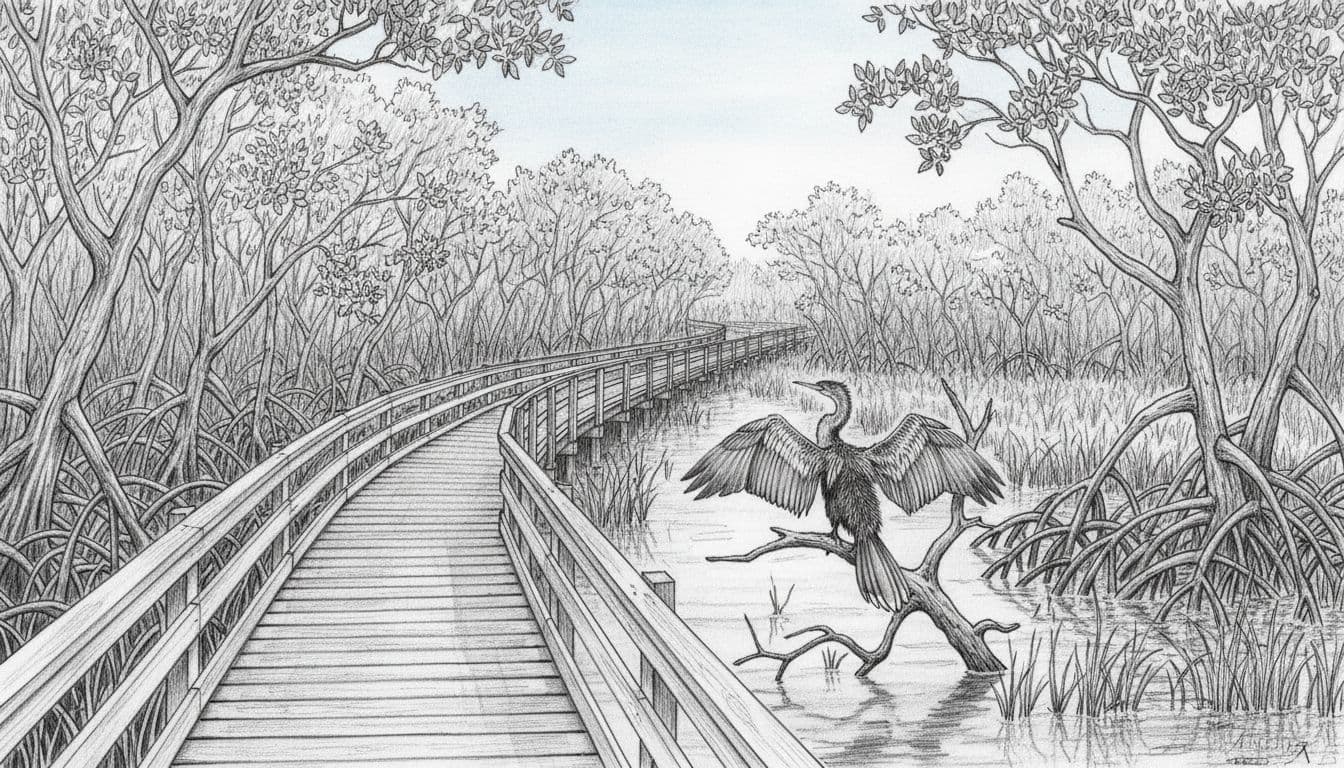
The Anhinga Trail is where the park usually clicks for first-timers. It is easy, short, and packed with life, which makes it a prime spot for bird watching. Even people who say they “aren’t into bird watching” tend to care when an anhinga dries its wings a few yards away or an alligator drifts under the boardwalk like a floating log with eyes.
After that, the Gumbo Limbo Trail feels like stepping into a different world. The dense shade and twisted trees offer a quick look at a hardwood hammock ecosystem, which breaks up the day nicely.
By midday, keep the stops brief. Pa-hay-okee Overlook is more about the big picture. It helps you understand that the Everglades is less a postcard scene and more a slow river spread across the land. Then Mahogany Hammock adds one more short, worthwhile walk before the road continues south.
At Flamingo, it is worth slowing down again. Visit the Flamingo Visitor Center and marina area, walk a bit, and scan for birds, manatees, or even American crocodiles. For another sample route, Florida on Foot’s one-day overview is useful, though sticking to this one corridor tends to make the day better.
What to pack, what to skip, and when to choose Shark Valley instead
Pack for the Everglades like you’re heading to a wet, sunny oven with mosquitoes. That means plenty of water, sunscreen, insect repellent, a hat, and light clothes that dry fast. Closed-toe shoes help, but you don’t need heavy hiking boots for this itinerary.
It is also smart to bring lunch or at least solid snacks. Food options inside the park are limited, and first-timers often waste time hunting for a meal instead of enjoying the drive. A picnic at a pullout beats a hungry, cranky detour every time.
What should you skip? On a first visit, there is no need to cram in an airboat tour, long ranger programs, and more than one entrance on the same day. Worth knowing: the airboat tours most people picture run with private operators along the Tamiami Trail, outside the park boundary, not through the National Park Service.
There is one exception. If you’re staying in Miami and want the shortest drive with the highest odds of seeing lots of alligators, Shark Valley is a smart alternate plan. Reached via the Tamiami Trail, Shark Valley has an observation tower for wide views, a tram tour for guided wildlife spotting, and bike rentals for the 15-mile loop road. In that case, spend the whole day there instead of trying to combine it with Flamingo. One entrance, one pace, one better day. For those skipping the south road, Big Cypress National Preserve makes another solid nearby alternative.
Everglades first-timer FAQs
Is one day enough for Everglades National Park?
Yes, if you keep your route tight. One day is enough to get a strong first impression and see wildlife, boardwalks, and the southern end of the park.
Which entrance is best for first-timers?
Homestead suits most people. It gives you more variety in one day than Shark Valley, even though Shark Valley often wins for raw alligator sightings. For a different type of experience on a future trip, consider the Everglades City entrance and the Ten Thousand Islands on the park’s western side.
What’s the best time of day to visit?
Early morning is best. Wildlife is more active, temperatures are lower, and the trails feel far more comfortable.
Can I do Shark Valley and Flamingo in one day?
It is possible, but not recommended. Because the two areas are more than an hour apart and not connected, combining them turns a calm park day into a long driving day, and that trade-off usually isn’t worth it.
Where should I go for kayaking?
The Everglades City entrance and the Ten Thousand Islands shine for kayaking, with quiet paddles through mangrove tunnels and coastal bays that are best suited to a longer visit.
One day in Everglades National Park works when you stop chasing every highlight and let the park come to you. Start early, keep your stops short, and follow the Homestead-to-Flamingo route.
For a natural Florida pairing, the Biscayne National Park one-day itinerary covers a park that sits about 45 minutes away, near the same Homestead area. For a broader look at the state’s best trails, the best hikes in Florida guide covers springs, dunes, and boardwalks across the state.
For another Florida park reached by ferry or seaplane, see the Dry Tortugas day trip guide.