Two days is enough to see the Grand Canyon South Rim well if the days are tight. Try to do everything at once and half the time gets spent in a car, waiting on a shuttle, or wondering why the day feels rushed.
This itinerary is built for first-timers who want the classic views, one short hike, and enough breathing room to actually see the canyon. The South Rim is open 24/7, year-round, but most of the planning levers (lodging, shuttle service, trail conditions) shift with the season. Check the NPS Plan Your Visit page before locking dates.
Before you go
- Entrance fee: $35 per vehicle for a 7-day pass. Motorcycle $30, per-person $20. America the Beautiful annual pass works
- South Rim is open year-round, 24/7
- Free park shuttles run on four routes: Village, Hermit Road, Kaibab Rim, and Tusayan (Tusayan route is summer only)
- Hermit Road is closed to private vehicles March 1 through November 30; access by shuttle only during that window
- South Kaibab Trailhead (Yaki Point) has no private vehicle access at any time, shuttle only
- Drive times: Flagstaff to South Rim ~1.5 hours; Phoenix ~3.5 hours; Las Vegas ~4.5 hours
- Cell service is reliable in the Village; spotty along Desert View Drive and below the rim
The two-day plan
| Day | Morning | Afternoon | Why it works |
|---|---|---|---|
| 1 | Visitor Center, Mather Point, Rim Trail to Yavapai Point | Bright Angel Trail short out-and-back, Village walk | Eases into the park without committing to a long hike |
| 2 | Sunrise on the rim, Desert View Drive out to Desert View Watchtower | Hermit Road by shuttle to Hopi Point and Hermits Rest for sunset | Widens the radius and covers both ends of the rim |
Day 1: rim views and one short hike
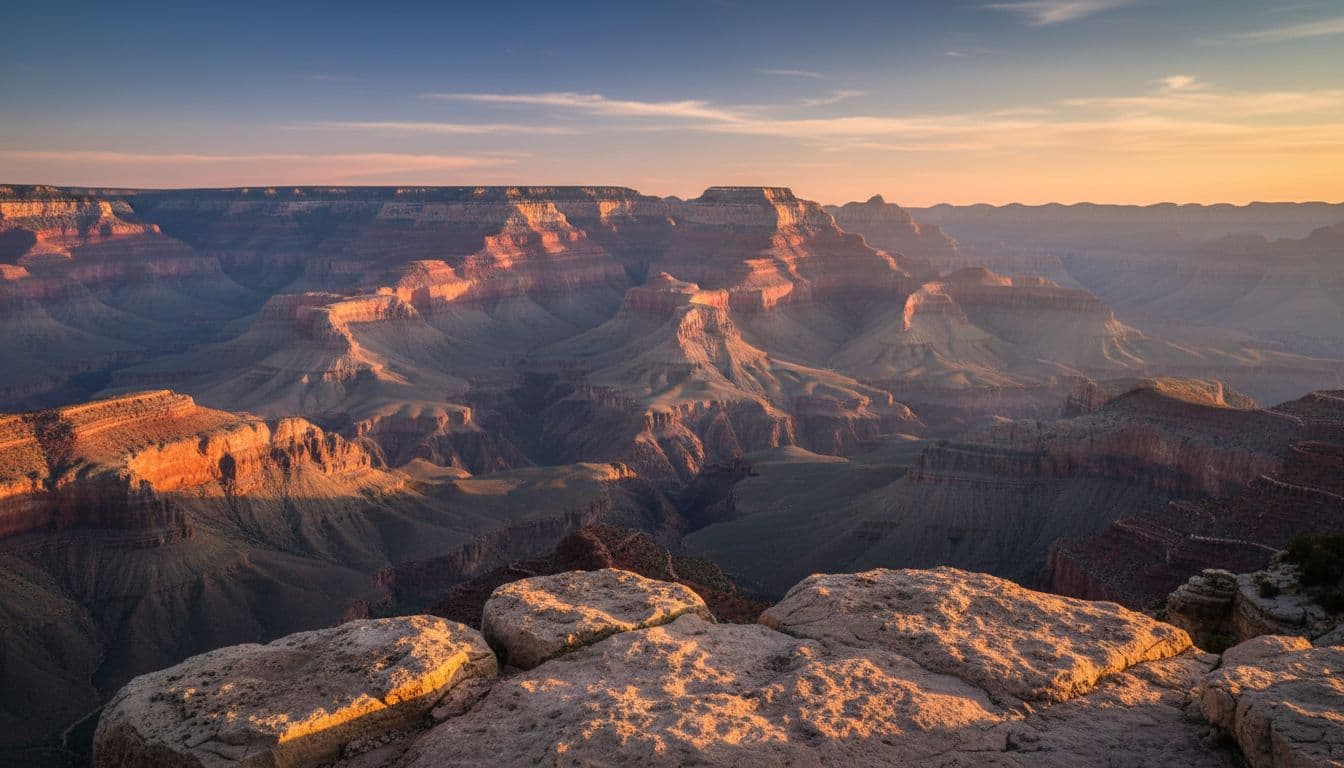
Park at the South Rim Visitor Center (the main lot off Highway 64) and walk to Mather Point first. It’s a five-minute walk from the visitor center and one of the best first looks at the canyon. From there, follow the paved Rim Trail west toward the Yavapai Geology Museum and Yavapai Point. The Grand Canyon South Rim map shows how close these viewpoints are; the walk between them is short and very scenic.
If the visitor center lot is full (it often fills by 10 am in peak season), park at the Backcountry Information Center or in Tusayan and take the shuttle in.
The first hike
Two solid first-time hike options:
- Bright Angel Trail — the classic corridor trail. From the Village trailhead, common turnaround points are the 1.5 Mile Resthouse (3 mi RT, ~1,100 ft elevation loss) or the 3 Mile Resthouse (6 mi RT, ~2,100 ft loss). Restrooms and water at both. NPS warns against going to Plateau Point or Indian Garden as a day hike
- South Kaibab Trail — accessed only by shuttle (no parking at the trailhead). Steeper, more exposed, with sweeping ridge views. Most first-time day-hikers turn around at Ooh Aah Point (1.8 mi RT) or Cedar Ridge (3 mi RT). The Colorado River isn’t visible until much farther down, around Skeleton Point (6 mi RT)
The cardinal rule on any inner-canyon hike: pick the turnaround point before starting. The climb back up takes roughly twice as long as the descent and is the leading cause of trail emergencies on the South Rim. The Grand Canyon day-hike turnaround times post breaks down the math.
Day 2: sunrise, Desert View, and Hermit Road
Mather Point and Yavapai Point are the classic sunrise spots on the South Rim because they face roughly east-northeast and the parking situation is straightforward. Sunset Point or any pull-off on Hermit Road is the answer for sunset.
After sunrise, head east on Desert View Drive (Highway 64). It’s about 23 miles from the Village to the Desert View Watchtower, with eight named viewpoints along the way. Major stops in driving order:
- Grandview Point
- Moran Point
- Tusayan Ruin and Museum
- Lipan Point (best Colorado River view from this stretch)
- Desert View Watchtower (Mary Colter-designed, open year-round)
Plan for at least 3 to 4 hours round trip on the Desert View loop, more if you stop at every overlook. Drive Desert View in the morning before tour-bus traffic builds.
For the afternoon, take the Hermit Road shuttle (the red route). The road is closed to private vehicles March-November. Eight overlooks between Trailview and Hermits Rest, with Hopi Point as the standard sunset spot. The full out-and-back takes about 80 minutes with no off-shuttle time.
Where to stay
- Inside the park (Grand Canyon Village) — El Tovar, Bright Angel Lodge, Kachina Lodge, Thunderbird Lodge, Maswik Lodge, Yavapai Lodge. Book 6-12 months ahead for peak season. Saves driving in every morning
- Tusayan — gateway town 7 miles south on Highway 64; shuttle into the park during peak season. Easier last-minute booking
- Williams — about 1 hour south on Route 66; the Grand Canyon Railway departs from here. Cheaper, more variety
- Flagstaff — about 1.5 hours south; bigger town with more dining and a separate base for Arizona road trips
If staying in Tusayan or Williams, factor the morning drive into the day. Both are reasonable bases when the in-park lodges are booked.
Pairing the Grand Canyon with other Arizona stops
Most first-timers come for the canyon, but the drive south makes for a natural road trip. The Sedona hiking itinerary covers a one-day plan two hours south. For desert and saguaros, Saguaro National Park sits outside Tucson, about 5 hours from the South Rim. For a broader Arizona list, best hikes in Arizona has options across the state. For the canyon’s quieter twin, the Grand Canyon North Rim is a 5-hour drive but worth a second trip.
Mistakes that eat the day
The biggest one is treating the South Rim like a drive-by. Every named viewpoint isn’t required. The Mather-Yavapai stretch on day one plus Desert View on day two covers most of what people come for.
The second is starting an inner-canyon hike too late in the day. Even a 3-mile out-and-back ends with a steep climb in full sun. NPS doesn’t recommend going past 3 Mile Resthouse on Bright Angel or past Cedar Ridge on South Kaibab as a day hike from May through September.
The third is ignoring the shuttle. Driving and parking at peak hours costs more time than the shuttle ride. Park once at the visitor center or at Backcountry Information, then ride.
Frequently asked questions
Is two days enough for the Grand Canyon South Rim?
Yes, for the standard first-time visit. Day one for the Visitor Center, Rim Trail, and one short hike. Day two for sunrise plus Desert View Drive and Hermit Road. Three days opens up a longer inner-canyon hike or a side trip to the Hualapai Skywalk on the West Rim.
What’s the best first hike on the South Rim?
Bright Angel Trail to the 1.5 Mile Resthouse (3 miles round-trip, about 1,100 feet of elevation loss). It’s well-maintained, has water and restrooms at the turnaround, and gives a real sense of being inside the canyon without a punishing climb back out. South Kaibab to Ooh Aah Point (1.8 mi RT) is the next-best short option.
How much does it cost to visit the Grand Canyon?
$35 per vehicle for a 7-day pass that covers both the South and North Rims. Motorcycles $30, per-person entry on foot or bike $20. America the Beautiful annual pass works.
Do I need to use the park shuttle?
Yes, in two cases. The South Kaibab trailhead at Yaki Point has no private vehicle access at any time, so the Kaibab Rim shuttle is the only way in. And Hermit Road is closed to private vehicles March 1 through November 30, so the Hermit Road shuttle is required during that window. For everything else, the Village shuttle is optional but useful.
Should I stay inside the park or in Tusayan?
Inside the park if you can book it, especially for sunrise on day two. The Village lodges (El Tovar, Bright Angel Lodge, Yavapai Lodge, Maswik Lodge, Kachina, Thunderbird) sell out 6-12 months ahead. Tusayan is a reasonable second choice and adds about 15 minutes of driving each morning.